Showing posts with label c-word. Show all posts

Monday, April 13, 2020

Who's Invited to the Lifeboat?

When fear spikes, when people cry out, when the ship starts to sink, who's in the lifeboats?

Did you even realize there were lifeboats or were you too busy trying not to drown? 

Was it invitation only? 

Who's invited to the lifeboats when things go wrong? 


When the Coronavirus pandemic hit the United States, we were delivered a message of "we're all in this together". If we all stayed home, followed executive orders,  and sheltered in place, we would all be safer and better off in the long run. But that's not exactly how it happened. Many people could stay home. Because they had the option and resources to work from home. They had substantial savings and assets to rest back on financially. They had food and could afford delivery services. When they needed to go out, they had reliable personal transportation and protective gear. They had support systems, resources, and safety nets. They managed to stay afloat when things got rocky. 

All of this rested on the most vulnerable in our population: the people who were already at risk of financial, emotional, and economical destruction without a life preserver in sight. This has looked like: low-wage employees continuing to go to work with out protective gear or paid sick time so the rest of society could continue to have grocery stores, delivery services, mail service, and more. They relied on public transportation, they brought the risk of the virus home to their families and overcrowded communities. They struggled. And that's best case scenario if they got to keep their jobs and had substantial child care. 

It feels necessary to point out, among the front line workers are the absolutely essential medical staff. They are putting their lives at risk every single day. And our communities would be in even greater devastation if it were not for them. There are a few major differences here from the at-risk community. For many front line medical workers, they received substantial emergency sick leave if they become ill with COVID-19, they are offered separate living spaces from their family if they become ill, and they have high lifetime earning potential. There is no question about how awful things are for them right now. But when this is over, for a vast majority of them, they will be able to afford therapy to cope emotionally, they will take their families on vacations to relax and reconnect, and their financial livelihood won't suffer, now or for years to come. 

But for many of our most vulnerable, this will be years, decades, potentially even generations of financial and emotional devastation. A stimulus check will not bring loved ones back. A new job making minimum wage does not reverse an eviction or repair a credit score that suffered from months of unemployment. Thoughts and prayers will not make space for them in the lifeboats. 

For them, their plight was years in the making. This is not a sudden circumstance of inequity. This is systemic patterns of keeping the poor, poor. Of marginalizing people of color. Of resting on the weakest to keep the most powerful afloat. Of carefully worded propaganda to maintain the imbalance of access to resources and opportunity. A country built on some, taking advantage of many.

The lifeboats were always there. The invitations went out a long time ago. If you weren't on the guest list, it's sink or swim.

Watch the people in the lifeboat.
See them waving as they head off on their voyage of privilege, safety, and opportunity.
Smiling with pity.
Grateful for your sacrifice. Your struggle. Your dollar. Your vote.

Are you paying attention? Who's invited to the lifeboat?


Sunday, April 5, 2020

Caution: Hazard Ahead


300+ Free Caution & Warning Vectors - Pixabay
Image credit: www.pixabay.com

Feeling short of breath? Feeling tightness in your chest? Is that coronavirus or stress or anxiety? Most people in our country right now are feeling some sort of anticipation around what's to come. But what exactly is the hazard head of us? And just how close is it? 

What are we so afraid of? 

There's a lot to keep us up at night. The threat of a lung-attacking virus, the rapid decline of our previously thriving economy, running out of supplies, children missing out on months of school, the constant social media bickering/shaming/bragging/joking, eating our way into a deep state of depression, the list goes on. And the biggest question of all is likely, how long is this going to last?  

The most consuming stress is not that any of the above things could happen - many of them are already happening. The overwhelming stress comes from not knowing. For the most part we can manage difficulty but our brain is relentless in trying to define, predict, and control what is happening. 

Brain states

On our best days, our brains toggle between thinking and feeling. This is important as we are a highly evolved and social species. We need both parts to function well as individuals and together as a society. And when danger looms, this is an essential response system that triggers quick processing to keep us safe, but also elicits big feelings that can sometimes feel out of control.

When the emotional part of our brain takes over, we struggle to think logically. This can skew our processing of a threat, activate big emotional responses, and increase our physical responses to stress. Those big emotions you're feeling are real, and so is the physical response. You're in a survival state and it's meant to protect you, even if it feels uncomfortable to be there.

Another aspect of our brains that we can't fight: our need to feel we are in control even when we aren't. This makes it difficult for us to sometimes recognize that we are in a survival state. Of course it's clear when we are crying, explicitly discussing our fears, or taking actions that mitigate the factors causing our stress. But there are other ways that we embody the effects of the survival state too.

Some of the signs are more attributable: being more short tempered, struggling to sleep, stress eating, and so on. But some are harder to correlate to looming stress. Among these are an increased need to be productive, doing these to make others feel good (more typically a need to make ourselves feel good), and oversharing on social media (seeking connection, needing to be seen).

Again, all of these responses are typical and real. So it's okay to be in your feelings a bit. Just don't sign a lease and get too cozy there. 

Long term

For the most part, our when our brains respond to stress, it's short term: processing immediate threat, and responding quickly with a priority on our immediate safety. Eventually our brain and our body return to a normal state. These kinds of response and recovery cycles are healthy to a point (also called tolerable stress).

But one of the big risks in our current situation is that this might not be short term. When we have prolonged exposure to a threat (toxic stress or trauma) the physical effects and long-term impact is significant, it actually rewires our brains and through epigenetics has an multi-generational impact. We've seen this with other historical trauma most notably slavery and the holocaust.

The long term risk for us at the given moment comes with the duration of ill health, lack of access to food, insufficient health care and medical resources, unemployment, and so on. Layered on this is the impact of new and pre-existing conditions of anxiety and depression.

What we are seeing now is that all classes of people around the world are being impacted by this complex historical event. But, at greatest risk are the already at-risk people in our community, our front-line workers, people without social safety nets; the people who have been at the bottom and are increasingly marginalized in this scenario. The threat of our current situation for certain groups is intense, traumatic, and potentially fatal. 

More on this in my next post: "Who's invited to the lifeboat?"


Friday, April 3, 2020

I Will Not


I Will Not Be Shaken - Download Free Vectors, Clipart Graphics ...
Image credit: www.vecteezy.com 

I will not.

I will not suffer through this pandemic.

I will not...
                  ...succumb to sadness

                  ...linger on things that aren't happening right

                  ...fear what I do not know

                  ...wallow in self-loathing

                  ...struggle alone

                  ...try to convince myself that my feelings aren't real

                  ...get caught up in other people's struggles

                  ...take for granted my privileges

                  ...drown in my anxious thoughts

                  ...dwell on wishing this wasn't happening
           
                  ...revert to unhealthy or dangerous coping strategies

                  ...forget that people still need me to show up for them

                  ...waste this opportunity to slow down

                  ...feel the pressure to accomplish something

                  ...judge others for how the handle uncertainty

                  ...abandon my values

                  ...let this temporary be my permanent

I will not let something out of my control, control me.

I will not be shaken.

I will not.


Tuesday, March 31, 2020

Puzzling

When my 30-year-old sister-in-law died unexpectedly, my husband, son, and I met a few other close family members at a remote lake house in South Carolina where we spread her ashes. We spent a few days there, no cell service, no internet, just us and our feelings.

We found ourselves spending most of our time huddled over a complex jigsaw puzzle. I don't even remember what the image was but I remember how consumed by it I was. We didn't talk, we just worked away at noticing common details in color and line, examining the shape of pieces, and silently delighting when we made a match.

In our current state of quarantine, we again find ourselves drawn to jigsaw puzzles. Things are significantly more chipper than the above mentioned memory but I realized there are some pretty strong parallels.

I found this, well, quite puzzling.

What is it about big feelings and despair that draws me to jigsaw puzzles?

It gives us something to do. A way to pass the time. Helps prevent our minds from lingering on the hurt, confusion, and uncertainty. It requires just enough mental engagement to avoid getting caught in our feelings.

They are predictable. We know how it's going to end. It's going to end how it is supposed to. Complete, with everything in it's place.  it is something can control. We can decide where to start, what to work on next, what to save for last. The end result is the same and we can count on that but we also get to choose how we get there. Quite the opposite when dealing with grief or anxiety or depression.

It requires patience. Despite the control and predictability we are afforded, puzzles also require an immense amount of patience. There is no short cut. There is no way to rush the process. Much like dealing with big emotions. There's no way to jump to the end, we just have to give it time and attention here and there.

How do you spend your time when you're alone with your feelings?


Sunday, March 29, 2020

We Are Not Brave


Ayn Rand Quote: “I'm not brave enough to be a coward; I see the ...
Image Credit: www.quotefancy.com 

I don't provide direct care to patients with COVID-19, I am the director at a child care center that provides care for the children of doctors treating COVID patients. Ever since the executive order to close non-essential businesses and stay home, my child care center has remained open and to provide care for hospital employees.

Everyday we get real time updates from the front lines - both the increasing intensity and the reassuring systems in place to protect people.

There is an amount of reassurance in having updates right from the source. But it is never lost on us what being that close to the action also means.

We recognize our increased risk of exposure. We recognize our increased likelihood of getting sick. We recognize the likelihood of one of the parents or child in our center community getting sick. And in all of that, the possibility of death, for us or someone we care about.

Despite all this, my teachers show up every single day. And they are playful, and loving, and truly present.

But let's be so clear, coming to work everyday is not an act of bravery. But we are not cowards.

Our sense of social responsibility is strong.
We understand how crucial it is for children to go through this uncertainty with familiarity and love.
We're heading out into the world to do our part to minimize the horrifying impact of this virus on our future.

Every single day when I wake up I have to remind myself that this is real.
People are getting sick.
People are dying.

I'm aware of the risk for me. For my two young children and my husband.
I'm scared every single day.
At least once a week I cry all the way home from work.

It's hard for me everyday to ask my teachers to keep coming to work, knowing they are afraid, knowing the risk is real.

But I do ask. And they do show up.

We are not brave, but we are not cowards. We just know this is bigger than us.

Saturday, March 21, 2020

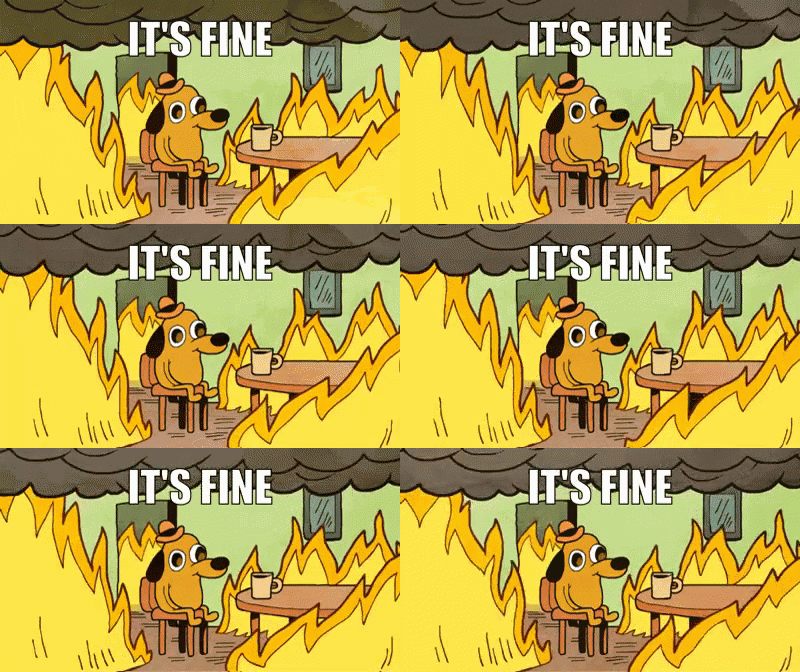
It's Fine

Image result for sips coffee in a burning building cartoon

In the past week, schools have closed, businesses have shut down, basic supplies are hard to find, we are restricted from gathering... and so much more. A lot of people are struggling with anxiety and depression. And that makes a lot of sense. This is hard to process and we don't know what is going to happen next.

My life is effected in several specific, immediate ways and the potential duration and severity of this situation could have many negative impacts. But I don't feel anxious or depressed at all. I feel calm, optimistic and energetic. I didn't think much of this at first. Maybe I'm just one of the lucky ones that is naturally resilient!

And then this week, Vicki Peterson of The Mighty wrote an article called "Feeling Calm in the Midst of the Coronavirus Pandemic Might be a Trauma Response". Oh. Damn. That's why this feels ok. I have so much practice carrying on when things are falling apart around me. My brain is actually wired differently.

I had a lot of feelings reading this article.

First, how lucky I am to have so much trauma that I can rally through a pandemic! Wait, lucky? That seems kinda messed up. I've never fault grateful for my trauma. But now, I can see how my resilience can be a gift in difficult situations. I am around a lot of people that are struggling right now. Remaining calm has allowed me to gather information, organize people, and make plans to help others.

Second, it hurts to be so seen. Every time my past trauma is brought into my current reality, it stings a little. This article was hard to read because it is right. I forget that little life stresses feel big to me and huge issues seem like a breeze. That's not normal. I've known for a long time that I'm most comfortable when things are a mess and life feels dysfunctional. I get anxious when things are good.

Third, a key point in this article is the eventual crash. Some day, it will knock me over all at once. But what I know from my past is that it probably won't happen this week, or this month, or even this year. It's like to happen years from now when I'm explaining to my children what it was like to live through this time, when I out loud admit all the hard parts, they will fall like pieces into one complete puzzle and I won't be able to look away. That's when the crash will come.

In this moment, I'm not oblivious. I'm not brave or unusual. I've just been in enough dark places that help me embrace these truths:  I know that things are bad. I know that bad things often get worse. I also know it's possible to come out on the other side.

Thursday, March 19, 2020

Don't say the C-word

You know the one. It's March 19th, 2020. You know the c-word we're all tired of hearing. It's kept us in our homes, children are out of school, there's a shortage on toilet paper. And no shortage of advice right now.

Don't take in too much social media. Stay on social media to be connected.
Don't feel like you have to be a teacher to your child. Be sure your child doesn't fall behind.
Don't go out into public. Keep going to work.
Don't fall for the hyped up media. Take this seriously.
Practice. Self. Care. Don't know what that is right now?

Here's my advice for you: Don't take my advice. Do you.

This is hard for all of us and what makes you feel better and able to function is going to be different.

For me:

I like information. It's soothing for me to understand what is happening.

I take walks every day. Even just 15 minutes. It feels good to breath and feel a sense of infinite space outside.

I play hard with my kids. We dance, we wrestle, we play board games. I run a child care center providing care to a major medical system. It is beyond stressful right now. I need to set it down for an hour and just be a mom.

I dance all the way to work to as loud and empowering music as I can find. Currently loving "Salt" by Ava Max and "Don't Start Now" by Dua Lipa.

I cry all the way home from work. Because the days are long. And it makes me feel good. And it would be so weird not to feel something right now.

I cuddle with my husband. We have had a great sex life for the 14 years we've been together. But right now this feels different. I know I'm not fully present for him due to my stress. But I also need the calm physical contact to bring me back into my body.

I take a shower every day and put on make up and wear cute shoes and my favorite accessories. Because when I show up fully and fabulous, I don't feel like so much is being taken from me.

Naming these things that are providing me comfort and relief helped me realize I don't need anyone else's list of how to squeeze in a gratitude FB post every day, vigorous exercise, write a note to 5 people, and so on. If that's your list, good, keep doing it.

And if it helps you, don't say the c-word. But if it does help, feel free to say all the c-words right now.


Too much and nothing at all.

When the words spill out. And they’re all wrong.   They’re too soon.   They’re too late.  When the words are all mixed up.  And upside d...