Showing posts with label Trauma. Show all posts

Sunday, August 16, 2020

By Your Scars

more-nail-with-holes-in-fence

There’s a classic story about a father teaching his son a lesson about anger and the permanent damage we can do with our words. It’s called “The Fence”. You probably know it but in case you don’t, here it is:

There was boy who had a bad temper, struggling to control his hurtful words and actions. 
His father gave the boy a bag of nails and told him every time he lost his temper, he must hammer a nail into their wood fence. 
The first day, the boy had driven 37 nails into the fence. Over the next few weeks, 
he discovered that it was easier to hold his temper than to drive those nails into the fence. 
As he learned to control his anger, the number of nails hammered daily gradually dwindled down. 
Finally the day came when the boy didn't lose his temper at all. 
His dad now had him remove one nail for each day that he controlled his temper. 
It took months, one by one, removing a nail for each day but finally all of the nails were gone.  
The father took his son by the hand, led him to the fence and said, "You have done well. But look at the holes in the fence. They fence will never be the same. When you say things in anger, they leave a scar, just like this one. You can put a knife in a man and draw it out. 
It won't matter how many time you say "I'm sorry", the wound is still there.
-Anonymous 
 

This story of course has a great lesson about the long term impact we can have when we are reckless with our words and actions. Even if we feel bad, apologize, and are forgiven, some scars will always remain. 

But this story also provides a metaphor with the damaged fence representing a damaged person. And while we should definitely be careful with one another, the scars we bear become who we are. They are our stories and what makes us unique. We don't see each other as polished pieces of wood, each alike and flawless. We fit together with our friends, chosen family, and partners by the way they see and tend to our scars.  The way they make space for our heartaches, hold our pain, and look straight in the eye of our adversity and don't look away. 

I know you have your scars. 
I know the places it hurts. 
I don't wish those parts of you away. 
I know you by your scars. 

Sunday, April 5, 2020

Caution: Hazard Ahead


300+ Free Caution & Warning Vectors - Pixabay
Image credit: www.pixabay.com

Feeling short of breath? Feeling tightness in your chest? Is that coronavirus or stress or anxiety? Most people in our country right now are feeling some sort of anticipation around what's to come. But what exactly is the hazard head of us? And just how close is it? 

What are we so afraid of? 

There's a lot to keep us up at night. The threat of a lung-attacking virus, the rapid decline of our previously thriving economy, running out of supplies, children missing out on months of school, the constant social media bickering/shaming/bragging/joking, eating our way into a deep state of depression, the list goes on. And the biggest question of all is likely, how long is this going to last?  

The most consuming stress is not that any of the above things could happen - many of them are already happening. The overwhelming stress comes from not knowing. For the most part we can manage difficulty but our brain is relentless in trying to define, predict, and control what is happening. 

Brain states

On our best days, our brains toggle between thinking and feeling. This is important as we are a highly evolved and social species. We need both parts to function well as individuals and together as a society. And when danger looms, this is an essential response system that triggers quick processing to keep us safe, but also elicits big feelings that can sometimes feel out of control.

When the emotional part of our brain takes over, we struggle to think logically. This can skew our processing of a threat, activate big emotional responses, and increase our physical responses to stress. Those big emotions you're feeling are real, and so is the physical response. You're in a survival state and it's meant to protect you, even if it feels uncomfortable to be there.

Another aspect of our brains that we can't fight: our need to feel we are in control even when we aren't. This makes it difficult for us to sometimes recognize that we are in a survival state. Of course it's clear when we are crying, explicitly discussing our fears, or taking actions that mitigate the factors causing our stress. But there are other ways that we embody the effects of the survival state too.

Some of the signs are more attributable: being more short tempered, struggling to sleep, stress eating, and so on. But some are harder to correlate to looming stress. Among these are an increased need to be productive, doing these to make others feel good (more typically a need to make ourselves feel good), and oversharing on social media (seeking connection, needing to be seen).

Again, all of these responses are typical and real. So it's okay to be in your feelings a bit. Just don't sign a lease and get too cozy there. 

Long term

For the most part, our when our brains respond to stress, it's short term: processing immediate threat, and responding quickly with a priority on our immediate safety. Eventually our brain and our body return to a normal state. These kinds of response and recovery cycles are healthy to a point (also called tolerable stress).

But one of the big risks in our current situation is that this might not be short term. When we have prolonged exposure to a threat (toxic stress or trauma) the physical effects and long-term impact is significant, it actually rewires our brains and through epigenetics has an multi-generational impact. We've seen this with other historical trauma most notably slavery and the holocaust.

The long term risk for us at the given moment comes with the duration of ill health, lack of access to food, insufficient health care and medical resources, unemployment, and so on. Layered on this is the impact of new and pre-existing conditions of anxiety and depression.

What we are seeing now is that all classes of people around the world are being impacted by this complex historical event. But, at greatest risk are the already at-risk people in our community, our front-line workers, people without social safety nets; the people who have been at the bottom and are increasingly marginalized in this scenario. The threat of our current situation for certain groups is intense, traumatic, and potentially fatal. 

More on this in my next post: "Who's invited to the lifeboat?"


Saturday, March 21, 2020

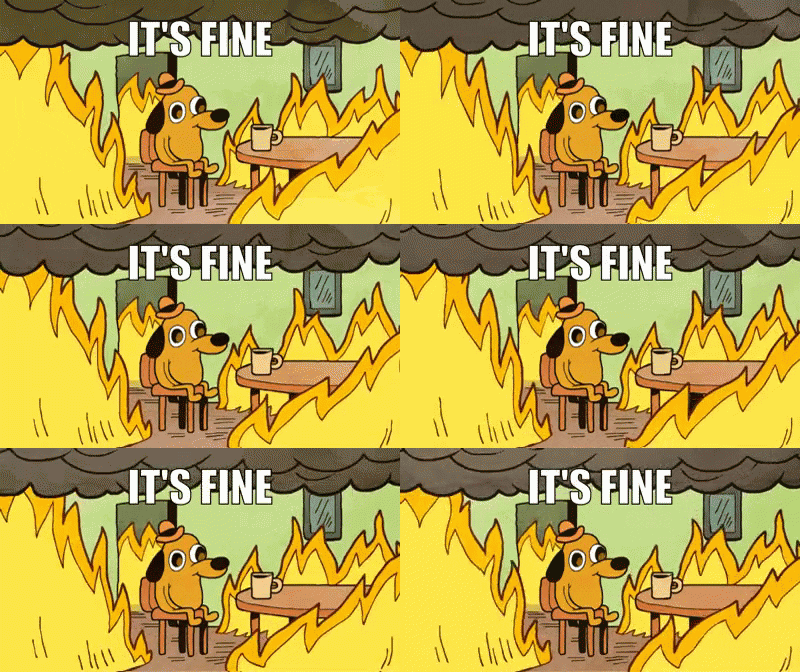
It's Fine

Image result for sips coffee in a burning building cartoon

In the past week, schools have closed, businesses have shut down, basic supplies are hard to find, we are restricted from gathering... and so much more. A lot of people are struggling with anxiety and depression. And that makes a lot of sense. This is hard to process and we don't know what is going to happen next.

My life is effected in several specific, immediate ways and the potential duration and severity of this situation could have many negative impacts. But I don't feel anxious or depressed at all. I feel calm, optimistic and energetic. I didn't think much of this at first. Maybe I'm just one of the lucky ones that is naturally resilient!

And then this week, Vicki Peterson of The Mighty wrote an article called "Feeling Calm in the Midst of the Coronavirus Pandemic Might be a Trauma Response". Oh. Damn. That's why this feels ok. I have so much practice carrying on when things are falling apart around me. My brain is actually wired differently.

I had a lot of feelings reading this article.

First, how lucky I am to have so much trauma that I can rally through a pandemic! Wait, lucky? That seems kinda messed up. I've never fault grateful for my trauma. But now, I can see how my resilience can be a gift in difficult situations. I am around a lot of people that are struggling right now. Remaining calm has allowed me to gather information, organize people, and make plans to help others.

Second, it hurts to be so seen. Every time my past trauma is brought into my current reality, it stings a little. This article was hard to read because it is right. I forget that little life stresses feel big to me and huge issues seem like a breeze. That's not normal. I've known for a long time that I'm most comfortable when things are a mess and life feels dysfunctional. I get anxious when things are good.

Third, a key point in this article is the eventual crash. Some day, it will knock me over all at once. But what I know from my past is that it probably won't happen this week, or this month, or even this year. It's like to happen years from now when I'm explaining to my children what it was like to live through this time, when I out loud admit all the hard parts, they will fall like pieces into one complete puzzle and I won't be able to look away. That's when the crash will come.

In this moment, I'm not oblivious. I'm not brave or unusual. I've just been in enough dark places that help me embrace these truths:  I know that things are bad. I know that bad things often get worse. I also know it's possible to come out on the other side.

Too much and nothing at all.

When the words spill out. And they’re all wrong.   They’re too soon.   They’re too late.  When the words are all mixed up.  And upside d...